
At some point in every bartender's career, you realize that the person you teach to make a signature cocktail might be more valuable than the drink itself. The cocktail revolution of the early 2000s did more than change the beverages we served; it transformed the industry. Forgotten books resurfaced, speakeasies returned and bartenders became obsessed with dilution, homemade syrups and technique. For many, bartending stopped being simply a job and became a craft worth studying.
Today, many of pioneers who helped drive that movement are no longer behind the bar every night. They have become managers, consultants, educators, brand ambassadors and perhaps most importantly mentors. Their influence may no longer be measured by the number of cocktails they serve in a night but by the number of people they have helped develop. The early advocates of modern craft bartending were not automatically given respect. They had to convince guests that there was more to the job than pouring quickly, proving that unusual ingredients could be interesting and that a well-made drink could take time.
South Africa developed its own interpretation of that global movement with Johannesburg, Cape Town, Durban and other cities building distinctive cocktail cultures shaped by local personalities, venues and communities. The current generation is building on that foundation. Today's young bartender does not necessarily have to explain what a Negroni is before making one. Guests are increasingly familiar with premium spirits, classic cocktails and modern techniques. They enter an industry with opportunities that previous generations fought to create. But access to knowledge does not mean knowledge can be taken for granted.
For most bartenders, there eventually comes a point when working service begins to mean something different. Perhaps your knees do not recover quite as quickly after a double shift. Maybe weekends with family become more important. Or perhaps you discover that developing people gives you the same satisfaction that creating drinks once did. Leaving the bar does not mean leaving the industry, often it means your influence is about to grow. The greatest legacy a seasoned professional can leave is knowledge.
Passing knowledge forward should never become an older bartender simply saying, "This is how we used to do things." Technical skills and discipline are vital, but knowing when to evolve is equally important. A veteran might teach a younger bartender how to survive a brutal Saturday night, while that same bartender might challenge the veteran to reconsider an outdated operational standard. That is not disrespect, that is called progress. Every generation brings something new to the table. Good mentors listen.
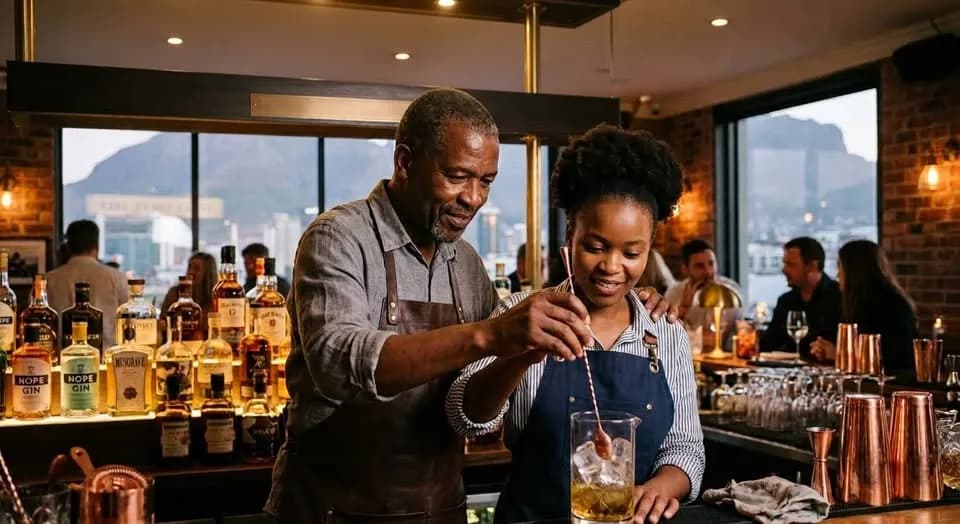
Showing a rookie how to properly hold a jigger might seem like a small moment, but it is another branch added to the industry's family tree. The teacher could be a manager, a formal mentor or simply the person working beside you, quietly demonstrating a better way. A professional learns something in Johannesburg and carries it to Cape town. Someone from Durban takes those standards into a bush lodge. A bartender from Gqeberha moves to another city and influences the local scene. Someone watches, someone learns and eventually someone teaches.
That is how an industry grows not because of one iconic venue or celebrity bartender but because people are willing to share what they know. Ingredients change, technology evolve, trends come and go. But the fundamentals remain: balance, technique, consistency and hospitality. Our progress depends on the exchange of ideas. Whether you are 25 or 55, there is something you can give to the person coming after you so put your knowledge to work. Find someone who reminds you of yourself when you first started.
Teach them the mechanics of the craft, but do not stop there. Teach them how to handle pressure without causing collateral damage. Teach them how to remain professional when service becomes difficult. Teach them how to take pride in their work when nobody is watching and then let them challenge you. The person you mentor might discover a better way to make operations sustainable and build a concept you never had the opportunity to pursue or teach you something you did not realize you needed to learn.
Knowledge does not belong to one generation. We borrow it, adapt it, question it and eventually pass it on. The cocktail revolution was never only about what went into the glass. It was about discovering how much there was still to learn and understanding that the responsibility of every generation is to make sure someone else is there to learn it. Because eventually, the best thing you leave behind will not be your signature cocktail. It will be the bartender who no longer needs you behind them.
End of story.

No comments yet. Start the conversation.